High Deductible Plans with HSA's
Encouraging Cost Transparency
Medicare, Medicaid, and employer-based, low deductible, high cost coverage blind both patient and physician to the cost of care. Nobody knows how much is spent. This is perhaps the single largest factor driving up the cost of American healthcare.
If you have a headache, ask your physician how much an MRI of your head will cost. Why the blank stare? The question is almost impossible to answer. If you are a physician, ask your patient if they need to know how much the MRI will cost. Most won’t care—they don’t have to pay.
This system is designed to fail. Neither the individual patient nor the treating physician is forced to consider the cost of care. Under the current system the only way to control healthcare spending is for either the government or the insurance company to limit access to care. Simply placing today’s uninsured patients\ on federal coverage does nothing to solve the problem of the third party payer.
Lower cost / higher deductable policies combined with Health Savings Accounts lower healthcare spending. They accomplish this by placing patients in control of their own healthcare dollars motivating them to ask two important questions:
- How much does this cost?
- Do I need this test?
As more Americans use lower cost / higher deductible plans with personal Health Savings Accounts, patients will increasingly ask “how much will this cost?” and “do I need to have this done?” When the public begins to consistently asks about cost, free market forces will encourage physicians and hospitals to make this information readily available.
For example: A man wants to have an MRI because of persisting headaches. Suppose there are two hospitals in his town that perform MRI’s. Hospital #1 readily tells him they will charge $800. Hospital #2 will not disclose the cost. More often than not he will choose Hospital #1.
Driven by free market forces, Hospital #2 will soon begin to disclose its pricing to compete for business. Simply giving patients a reason to ask “how much will this cost?” can effect this change without a government mandate.
Which Employer Plan Limits Cost Increases?
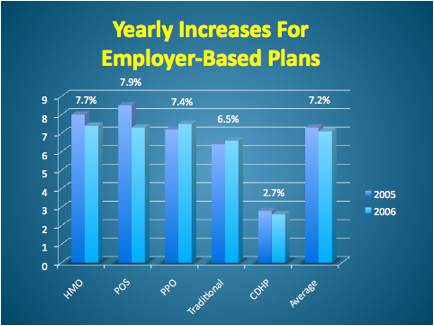
Note the fourth column, CDHP. This stands for Consumer Driven Health Plan, another name for lower cost / higher deductible plans combined with Healthcare Savings Accounts. While the cost of other plans grew at an average of 7.34% per year over this two-year period the CDHP’s grew at an average rate of 2.7%.
Multiple studies, including this CIGNA STUDY, demonstrate that giving patients control over their own healthcare dollars will actually lower the cost of healthcare by approximately 13% while increasing the use of preventive medicine.
When implemented by businesses, this strategy not only decrease healthcare sending without compromising access to care, it reduces the rate of growth of healthcare spending over time. Grace-Marie Turner of the GALEN INSTITUTE presented this data to Congress:
Let’s assume for the sake of argument this was an unusually good two-year period for CDPD’s. Let’s assume they will actually grow at a rate of 4%. This still amounts to significant savings over time:
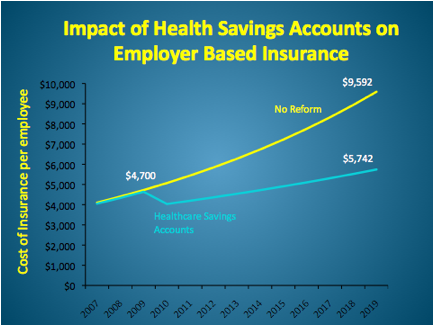
We often hear about “bending the curve.” There is a way to control the cost of healthcare without government rationing. If America could reduce even one fourth of its healthcare spending by even 10%, this will save $50 billion every year.
Let Patients Control Their Own Healthcare Dollars
Opening the market to low cost, higher deductible, private health insurance policies will solve multiple problems by placing the patient in charge of their own healthcare dollars. Individual, lower cost, higher deductible policies combined with Health Savings Accounts (HSA’s) will impact multiple issues:
- Return power to the patient by giving them control over their hard earned healthcare dollars.
- Encourage patients to ask about pricing and seek the most effective and efficient care.
- Effect price transparency through free-market pressure, not legislative mandate.
- Raise both patient and physician awareness of healthcare costs.
- Make insurance companies responsive to patient needs, not employers or special interest groups.
- Make health insurance transportable. You keep your coverage if you change jobs or move to another state.
- Lower the cost of healthcare without restricting patient access
These changes begin to address the skyrocketing cost of healthcare. Whole Foods, a major west coast grocery chain, instituted a higher deductible, lower cost policy and placed money in a Health Savings Account for each employee. Healthcare costs decreased by 13% the first year. The response? When put to a vote, 77% of employees voted in favor of keeping more control over their own healthcare dollars.
Reducing even one fourth of the total healthcare dollars spent in the U.S. by even 10% would save $50 billion every year without restricting access to care or using burdensome government regulations. This savings is accomplished simply by giving patients a reason to ask two questions:
- Do I really need this test or medication?
- How much will it cost?
Nobody spends someone else’s money as wisely as they spend their own.
Lowering the cost of healthcare will lower insurance premiums allowing more people to afford coverage. Increasing the number of insured will reduce the need for cost shifting (the cost of caring for patients who cannot pay is shifted to those who can). This in turn will decrease the cost of insurance making it yet more affordable.
Expand Pre-Tax HSA’s and Link them to Retirement Accounts
One challenge of healthcare reform is the problem of the “young invincibles.” These young, healthy Americans are at low risk for significant disease. Given the high cost of insurance, they elect to go uncovered rather then spend several thousand dollars each year on an insurance plan they feel they are unlikely to use.
Unfortunately, whether from devastating disease or an accident, a portion of these individuals will face significant healthcare needs. This shifts tens to hundreds of thousands of dollars of medical expenses from one uninsured individual to those who purchased insurance.
The Patient Protection and Affordable Care Act deals with this problem by everyone to purchase insurance through the Individual Mandate. An alternative solution is to create a compelling reason why it is in their best interest to purchase insurance.
According to the 2010 U.S. Census 49.9 million people did not have health insurance. Of these 8.8 million (17 percent) had annual incomes of more than $50,000, and an additional 9.5 million (19 percent) had incomes or more that $75,000.i
If the HSA contribution limit was expanded to $10,000 annually, and patients could move half of any unused HSA money to an IRA, this would significantly expand how quickly individuals could save for retirement. When combined with other reforms that will decrease the cost of health insurance, these measures would encourage nearly 20% of those presently uninsured to purchase insurance.

